Artists

Barry Le Va


b. 1941, Long Beach CA

Selected Press

Barry Le Va: Voltage The Brooklyn Rail - February 2008

Thought, as I experience it, is generally an unpredictable, often murky process. Sometimes a whole strain of interesting thought may spring on me fully formed and unannounced, one facet leading smoothly into the next, complete and beautiful. If I'm lucky, I have a pencil handy. But those are rare and beneficent days. For the most part, the act of thinking is a muddled disappointing and tedious journey over well-worn ruts and patches of quick sand up to my neck. Writing is most like quick sand because in writing, you must actually organize your thoughts and, beyond a vague notion of electricity in the brain merging with cumulative life experience, I have almost no idea what thought is.

Download PDF (102 K)


Barry Le Va: Reconfiguring Barry Le Va Art in America: May - 2005 

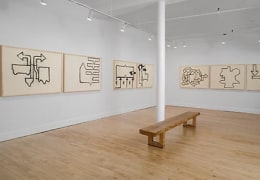
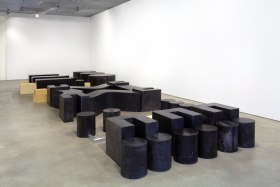
In an opening-day walk-through of the big, densely installed and (in both senses) stunning survey of his work at the ICA in Philadelphia, Barry Le Va offered this insight: “Ultimately it becomes a question of, can you tell the difference between order and disorder?” It’s a very good question. Like most Conceptualist-type puzzles, it suggests others: Is distinguishing order from its opposite a primary problem for Le Va or an ancillary one, tangent to concerns with symbolic content? Or, with respect to his famously sleuth-baiting work, is it altogether a red herring? And, not least, how much importance should we attach to what the artist says?

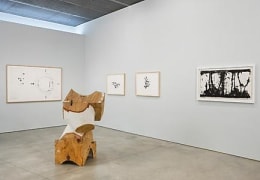
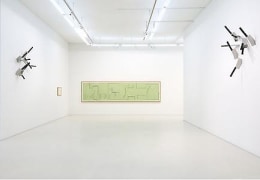
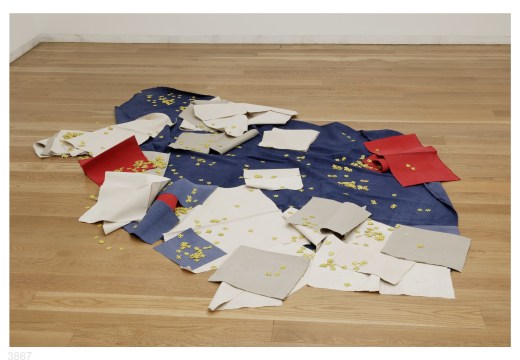
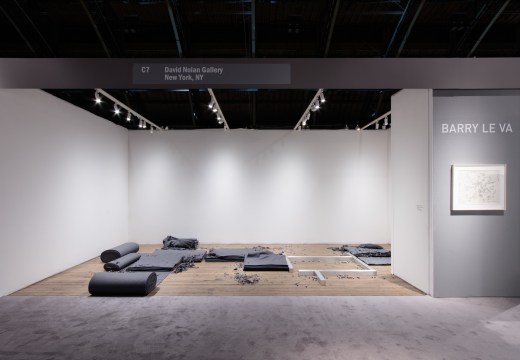
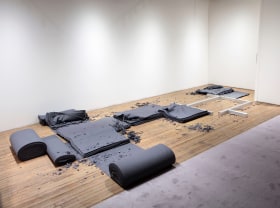
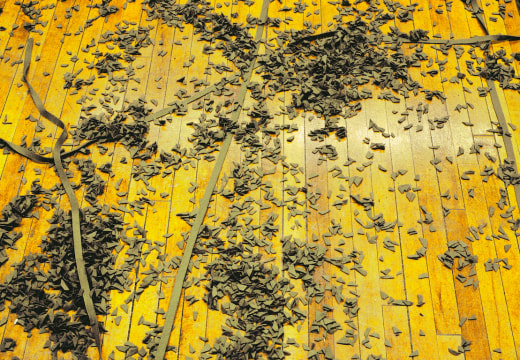
The last arises because Le Va’s work long seemed paradigmatic for a forceful challenge to any artist’s expressive priority. The celebrated November 1968 Artforum cover that launched his career showed nondescript little felt squares and ribbons strewn unevenly across a wooden floor. In other words, seemingly uncreated work by an unknown artist form no place in particular (the 27-year-old Le Va was then living in Los Angeles). Diffident as dust apparently as random as a toss of the dice, Le Va’s early floor exercises provoked abounding confusion. Robert Storr has written that in the mid-1960s, “Barry Le Va first made his mark with multi-media ‘scatter-pieces’ (a genre the artist more or less invented).” On the other hand, Pamela M. Lee insists, in the current exhibition’s catalog, that “Le Va was never a scatter artist…. Le Va’s process staunchly contravenes the associations of the arbitrary” (though, shes says, Andre, Serra et al. embraced it). For his part, Le Va doesn’t like the word scatter and says, moreover, “I hate the term anti-form”- which was also in circulation in the late 1960s- “because everything has form.” “Distribution “ is the word he prefers.

Download PDF (5.2 MB)


Carroll Dunham on Barry Le Va Artforum - March 2005

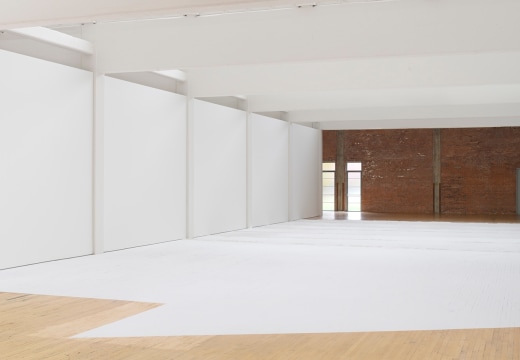
Barry Le Va's art of the late 1960's so perfectly typified the advanced aesthetic strategies of that turbulent moment that one almost feels he would have to have been invented if he didn't already exist. His sculptures represented a heightened, take-no-prisoners distillation of ideas drifting in the air, which in relative isolation and with almost telepathic clairvoyance he synthesized in an extremely original way. In November 1968, the completely unknown twenty-seven-year-old California artist appeared on the cover of Artforum, with an image of a large stretch of wooden floor, scattered with apparently random strips and little scraps of gray felt. Inside the magazine were pictures of various installations with myriad fragments of cloth, ranging from large bolts to ribbons and tiny cuttings, dispersed across the floor in enormous and otherwise empty rooms. With their emphatically horizontal spatial development, lack of internal armatures, and embrace of empty space as a physical platform, these works were clearly connected to those of approximate peets like Richard Serra, Keith Sonnier, and Bill Bollinger, and to European artists, particularly those associated with arte povera, such as Luciano Fabro and Mario Merz.

Download PDF (16 MB)