INDEPENDENT 20TH CENTURY: BOOTH 310
THE OBSESSIVE IMAGE
The Obsessive Image, a collaborative presentation by Gió Marconi Gallery and David Nolan Gallery, explores the recurrence of images, forms, and artistic preoccupations across twentieth-century art. While repetition is one manifestation of obsession, the exhibition considers a wide spectrum of obsessive artistic behavior: the return to a single image, motif, or medium; the meticulous refinement of craft; the accumulation of forms over decades; and the compulsive need to investigate an idea beyond conventional limits. Bringing together Italian and European artists with art of the Americas, the presentation reveals connections between formally and conceptually distinct practices from different generations and cultures, tracing how obsession, in its many forms, becomes a mode of seeing as much as a way of making.
In a culture defined by progress and acceleration with the relentless circulation of news, images, the pressure of markets, and the obsessive measurement of time and productivity, the artists in this exhibition offer a different proposition: that to return to the same image, or form, or the same question or concept, is a very meaningful way to move forward. Artistic obsession slows time. This presentation makes the case for that paradox.
David Nolan has maintained a gallery in New York City since 1987, juxtaposing work made in a variety of media by international artists from different generations and cultures, as well as mounting tightly-curated historical exhibitions. Nolan began his career in 1980 at Michael Werner Gallery, Cologne, and moved to New York in 1983 to work with Ileana Sonnabend. Now located in TriBeCa at 74 Leonard Street, his program is known for presenting artists whose work upsets familiar hierarchies of vision and meaning.
Gió Marconi Gallery was founded in 1990 by Gió Marconi, who had previously established Studio Marconi 17 — an experimental space for young artists and curators that he ran from 1987 to 1990. Over the three decades that followed, the gallery developed a vibrant and consistent program, marked by brave choices often well ahead of their time. Throughout, the gallery has supported the careers of its artists, promoting their diverse practices to audiences and institutions at home and abroad. While its focus has always been on contemporary positions, the program has gradually expanded to include historical artists from the Studio Marconi legacy.
-

-
WORKS
-
Valerio AdamiToys, 1965acrylic on canvas24 3/4 x 27 1/2 x 3/4 in (63 x 70 x 2 cm)
-
Richard ArtschwagerSplatter Table (Empire), 2011laminate, acrylic, mirror, and woodleft panel: 29 x 11 in (73.7 x 27.9 cm)
right panel: 27 1/2 x 21 1/4 in (69.8 x 54 cm) -
Richard ArtschwagerLocations, 1969formica on wood and 5 blps : wood, glass, plexiglas, mirror and rubberized horsehair with formica, metal chain15 x 10 3/4 x 5 in (case)
-
Enrico BajMobile (a Raymond Queneau), 1961inlay on fabric laid on panel21 1/2 x 15 x 1 1/8 in (54.5 x 38 x 3 cm)
-
Enrico BajSpecchiera, 1959mirror collage on board26 3/8 x 18 1/2 x 6 3/4 in (67 x 47 x 17 cm)
-
Hans BellmerUntitled, 1937gouache on black paper11 1/8 x 8 5/8 in (28 x 22 cm)
-
Tony BerlantRed snake, c. 1967found metal collage with steel brads on wood14 1/8 x 10 1/4 x 14 5/8 in (36 x 26 x 37 cm)
-
Tony BerlantWar Games, 1967found metal collage with steel brads on wood7 7/8 x 8 1/4 in (20 x 21 cm)
-
Tony BerlantThe Untitled Pilot, 1965found metal collage with steel brads on wood8 7/8 x 7 5/8 in (22.5 x 19.5 cm)
-
Joseph BeuysElektroden, 1970smixed media24 x 18 in (61 x 45.7 cm)
-
Chakaia BookerReasonable Doubt, 2026rubber tires and wood18 x 16 x 13 in (45.7 x 40.6 x 33 cm)
-
Miguel Rio BrancoYellow and Black Chess, 1985Type-C photograph29 1/4 x 44 in (74.3 x 111.8 cm)Edition of 3 (#2/3)
-
Hsiao ChinSinking, 1964ink and acrylic on canvas19 3/4 x 13 3/4 x 1 in (50 x 35 x 2.5 cm)
-
Gianni ColomboSpazio elastico - 6 linee doppie bianche, 1974-76painted wood, nails, and elastic cord28 3/4 x 28 3/4 in (73 x 73 cm)
-
William CopleyFrom "The Ballad of Hank the Finn", 1994felt-tip marker on paper30 x 24 in (76.2 x 61 cm)
-
William CopleyAcrobats (2 works)wood, painted cardboard and fabric10 1/4 x 2 3/4 in (26 x 7 cm)
-
Lucio Del PezzoIl bersaglio, 1966acrylic on panel48 x 31 7/8 x 4 in (122 x 81 x 10 cm)
-
Julia FishFirst plan for floor [ floret ] — section five, 1998gouache on assembled, laser-printed paper11 3/4 x 24 in (29.8 x 61 cm)
framed: 14 3/4 x 26 5/8 in (37.5 x 67.6 cm) -
Victoria GitmanUntitled, 2006oil on board4 3/8 x 6 in (11.1 x 15.2 cm)
10 x 11 1/2 x 1 3/4 in (25.4 x 29.2 x 4.45 cm) -
George GroszStickman with Flag for Freedom, 1946watercolor and brush and ink on paper (recto); brush and ink on paper (verso)21 7/8 x 14 1/8 in (55.5 x 36 cm)
framed: 27 1/4 x 21 1/4 in (69.2 x 54 cm) -
Richard HamiltonKent State, 1970crayon on paper22 1/4 x 30 in (56.5 x 76.2 cm)
framed: 24 3/8 x 32 1/4 x 1 3/8 in (62 x 82 x 3.5 cm) -
Mona HatoumNo Way II, 1996enamel and stainless steel10 3/4 x 8 3/4 x 5 in (27.3 x 22.2 x 12.7 cm)Edition 2 of 6, with 1 AP
-
Mel KendrickUntitled, 1986wood36 x 16 x 19 in (91.4 x 40.6 x 48.3 cm)
base: 37 x 12 x 12 in (94 x 30.5 x 30.5 cm) -
Martin KippenbergerUntitled (Zwerg vor Kanone), 1996concrete, wood and steeldimensions variable
-
Barry Le VaUntitled, 1994ink and graphite on paper9 x 12 1/2 in (22.9 x 31.8 cm)
framed: 14 1/8 x 18 1/8 in (36 x 46 cm) -
Alice MaherMound, 2000rose thorns and wood6 1/2 x 7 x 8 1/2 in (16.5 x 17.8 x 21.6 cm)
-
Henri MichauxUntitled, 1963felt tip, pencil on paper12 3/4 x 9 7/8 in (32.5 x 25 cm)
-
Henri MichauxUntitled, 1963felt tip on paper12 3/4 x 9 7/8 in (32.5 x 25 cm)
-
Louise NevelsonUntitled, 1970cardboard, metal foil, paper, and wood collage on board19 3/4 x 15 3/4 x 1/4 in (50 x 40 x 0.5 cm)
framed: 22 1/2 x 18 3/8 x 1 7/8 in (57 x 46.8 x 4.7 cm) -
Louise NevelsonUntitledcardboard, ceramic, glass, paint, paper, and wood9 x 11 x 10 in (22.9 x 27.9 x 25.4 cm)
-
Jim NuttDid You Hear Something?, 1981acrylic on canvas14 x 12 in (35.6 x 30.5 cm)
-
Jim NuttTart Broad, 1966paint on found breadboard, found metal box, darts, cotton, sponge rubber, string…board: 31 x 22 3/4 x 5/8 in (78.7 x 57.8 x 1.6 cm)
metal box: 2 1/2 x 11 1/4 x 5 1/2 in (6.3 x 28.6 x 14 cm) -
Eduardo PaolozziTyko, 1966chromed steel sculpture5 7/8 x 19 3/4 x 15 3/4 in (15 x 50 x 40 cm)
-
Gianfranco PardiGiardino pensile, 1969enamel and aluminum on board31 1/2 x 23 5/8 x 1 5/8 in (80 x 60 x 4 cm)
-
Arnaldo PomodoroBassorilievo, 1968silver with chrome-plated brass frame and base6 1/2 x 9 1/4 in (16.5 x 23.5 cm)Edition of 2 plus AP
-
Man RaySmoking Device, 1959/1970wooden test tube stand, plastic hose pipe, and glass marbles9 x 8 5/8 x 4 in (23 x 22 x 10 cm)
-
Man RayBoule sans neige, 1927/1970plastic assemblage9 7/8 x 6 1/4 x 6 1/4 in (25 x 16 x 16 cm)Edition of 10, Studio Marconi, Milan 1970
-
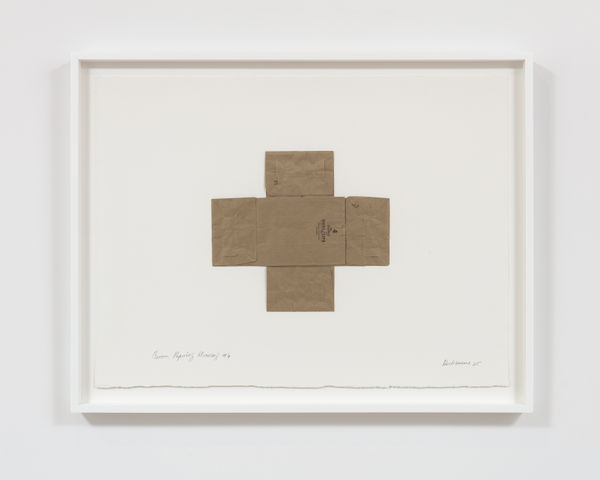
Dorothea RockburneBrown Paperbag Drawing #4, 2025brown paper bags on paper22 3/4 x 30 in (57.8 x 76.2 cm)
framed: 26 x 33 1/4 in (66 x 84.5 cm) -
Dorothea RockburneMagnus #6, 1979vellum, pencil, colored pencil, and glue22 1/2 x 30 in (57.1 x 76.2 cm)
framed: 26 1/4 x 33 3/4 in (66.7 x 85.7 cm) -
Dieter RothMotorradfahrer (Motorcyclist), 1969acrylic over toy motorcycle4 15/16 x 6 3/4 x 4 1/2 in
12.5 x 17.1 x 11.4 cm -
Mario SchifanoUntitled, 1963enamel and pencil on paper27 1/2 x 39 3/8 in (70 x 100 cm)
framed: 28 3/8 x 40 1/8 in (72 x 102 cm) -
Mario SchifanoPropaganda, 1962pencil and frottage on paper19 1/8 × 26 in (48.5 x 66 cm)
framed: 25 7/8 × 32 5/8 × 1 5/8 in (65.6 x 82.8 x 4 cm) -
Emilio TadiniPittura (Color & Co.), 1970acrylic on canvas28 3/4 x 23 5/8 x 1 1/8 in (73 x 60 x 3 cm)
framed: 30 7/8 x 25 5/8 x 1 5/8 in (78.5 x 65 x 4.2 cm) -
William T. WileyNovel Idea, 1971wood, leather, and chamois2 3/8 x 7 1/2 x 8 1/4 in (6 x 19 x 21 cm)
-


![Julia Fish First plan for floor [ floret ] — section five, 1998 gouache on assembled, laser-printed paper 11 3/4 x 24 in (29.8 x 61 cm) framed: 14 3/4 x 26 5/8 in (37.5 x 67.6 cm)](https://static-assets.artlogic.net/w_600,c_limit,f_auto,fl_lossy,q_auto/artlogicstorage/davidnolangallery/images/view/7fec34a64e8464adcfb77ffdfbe9a3ecj/davidnolangallery-julia-fish-first-plan-for-floor-floret-section-five-1998.jpg)